In 2026, packaging buyers will face a market shaped by cost pressure, stricter environmental expectations, and faster product cycles. The Packaging Market is no longer driven by volume alone. Buyers now compare material efficiency, supply reliability, recyclability, and regional compliance before signing contracts.
Smithers’ The Future of Global Packaging to 2028 estimates that worldwide packaging demand will approach 1.2 trillion dollars by 2028. Growth is expected across flexible packaging, paper-based formats, rigid plastics, and protective transport solutions. However, growth does not automatically mean progress. UNEP’s Turning off the Tap reports that packaging represents a major share of global plastic use, while much packaging waste still escapes effective collection and recycling systems. The practical warning is clear. A recyclable label means little without suitable local infrastructure.
The 2026 trends will therefore look different across markets. In Europe, buyers may prioritize recycled content, traceability, and documented environmental performance. In Asia and emerging markets, affordability, lightweight design, and durable logistics protection may remain more urgent. PMMI industry research also highlights automation, smart packaging, and operational efficiency as important investment areas. A small QR code, a thinner pouch, or a properly sized shipping carton can create measurable value. Yet forecasts can miss sudden shifts in energy prices, regulations, or consumer behavior. Buyers should test supplier claims, request verified data, and review total costs beyond the purchase price. The strongest strategy is not always the newest material. Sometimes, it is a simpler package that performs reliably.
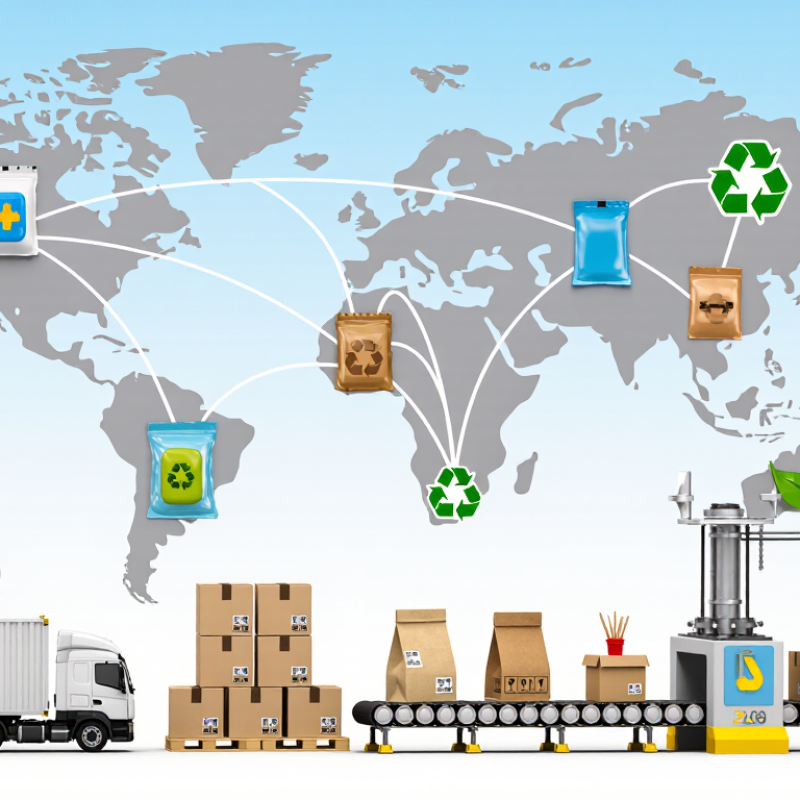
2026 Top Packaging Market Trends for Global Buyers
Definition and Scope of the Global Packaging Market in 2026
The global packaging market covers containers, wraps, closures, labels, and protective materials. It also includes packaging equipment, design services, and supply-chain solutions. Smithers estimates the market exceeded 1.2 trillion US dollars in 2023. Its report, The Future of Global Packaging to 2028, projects continued growth through 2028. Definitions still vary between research firms.
The market includes primary packaging touching the product. Secondary packaging groups individual units for retail handling. Tertiary packaging supports storage and transport, including pallets, cases, and stretch materials. Major materials include paperboard, corrugated fiber, flexible films, rigid plastics, glass, and metal. Food, beverages, healthcare, personal care, and industrial goods remain key end-use sectors.
Regional scope matters for global buyers. Asia-Pacific represents the largest production and consumption base, according to several industry assessments. Demand is also rising for lightweight formats and fiber-based protection. The OECD’s Global Plastics Outlook highlights growing pressure to reduce plastic waste and improve circularity. Yet, recycled-content data remains uneven across countries. That weakness can distort supplier comparisons.
A serious 2026 market definition should track volume, value, material mix, format, end use, and region. It should also separate virgin, recycled, reusable, and refillable systems. The boundary is not perfectly clean. Reuse may be counted as packaging sales, service revenue, or logistics activity. Buyers should verify each report’s methodology before comparing forecasts.

2026 Top Packaging Market Trends for Global Buyers
Packaging buyers are giving greater attention to material performance, recyclability, and verified supply information. Paperboard remains strong for cartons, sleeves, and food boxes because it offers print quality and efficient storage. Recycled plastic is growing in bottles, trays, and protective components, although supply consistency can vary by region. Flexible films still support snacks, personal care items, and lightweight shipping packs. Glass and metal remain valuable for products needing strong barriers, durability, or a premium physical feel.
Product categories are becoming more specialized. E-commerce packaging needs cushioning, tamper evidence, and compact dimensions. Food packaging requires moisture, oxygen, and temperature resistance. Personal care packaging often combines rigid containers with pumps, caps, or refill formats. In sourcing reviews, I have found that a material can look sustainable but perform poorly during transport. That gap deserves careful testing. Some choices remain difficult.
Tips: Request material specifications, recycled-content evidence, and migration or safety test reports where relevant. Compare full packaging weight, not only the main container. Check compression, seal strength, drop resistance, and warehouse conditions before approving samples. Ask suppliers about lead times and backup materials. A cheaper option may create more waste through damage. Regional recycling systems also differ, so buyers should avoid assuming one design works everywhere.
| Packaging Material | Key Product Categories | Main 2026 Demand Drivers | Typical Applications | Circularity Profile | Buyer Priorities | 2026 Market Direction |
|---|---|---|---|---|---|---|
| Corrugated Board | Shipping cartons, mailer boxes, protective inserts | E-commerce distribution, retail replenishment, lightweighting, fiber-based substitution | Consumer goods, food delivery, household products, industrial shipments | Widely collected and recycled where paper recovery systems exist; fiber quality declines after repeated recycling | Verified recycled content, fiber sourcing, compression strength, moisture resistance, minimal coatings | Strong growth |
| Paperboard and Folding Cartons | Folding cartons, sleeves, display boxes, food-service packs | Plastic reduction targets, premium shelf presentation, print customization, recyclable mono-material designs | Dry food, personal care, pharmaceuticals, consumer electronics | Generally recyclable when free from incompatible laminates, excessive coatings, and food contamination | Food-contact compliance, recycled fiber availability, barrier coating compatibility, recyclability labeling | Strong growth |
| Rigid Plastic | Bottles, jars, tubs, trays, closures, containers | Durability, low weight, product protection, recycled-content mandates, improved sorting and recycling infrastructure | Beverages, food, home care, cosmetics, healthcare products | Recycling performance is strongest for commonly collected resin types and simple, separable formats | Resin identification, recycled-content documentation, design for sorting, label and closure compatibility | Stable with redesign |
| Flexible Plastic | Pouches, sachets, films, wraps, bags, liners | Low material use, extended shelf life, convenience, portion control, lightweight logistics | Snacks, frozen food, pet food, detergents, agricultural products | Often difficult to collect and recycle because of low weight, multilayer structures, contamination, and limited facilities | Mono-material structures, downgauging without performance loss, recyclable sealants, clear end-of-life instructions | Innovation-led growth |
| Glass | Bottles, jars, vials, cosmetic containers | Premium positioning, inert product protection, refill systems, chemical resistance, high barrier performance | Food, beverages, fragrances, cosmetics, pharmaceuticals | Can be recycled repeatedly without loss of material quality; collection and color separation affect recovery | Recycled cullet availability, transport efficiency, breakage protection, refill feasibility, color requirements | Stable and premium-focused |
| Aluminum | Cans, aerosol containers, trays, tubes, foil structures | High barrier performance, lightweighting, beverage demand, recyclability, recovery value | Beverages, food, personal care, pharmaceuticals, household products | Highly recyclable; recycling saves substantial energy compared with primary aluminum production, while collection rates vary by market | Verified recycled content, alloy compatibility, coating compliance, dent resistance, supply security | Positive growth |
| Wood and Molded Fiber | Pallets, crates, corner protectors, molded-pulp trays, cushioning | Plastic foam replacement, protective transit packaging, renewable-fiber demand, e-commerce shipping | Fresh produce, electronics, appliances, industrial goods, food-service items | Wood packaging can be reused or recovered; molded fiber is generally recyclable or compostable only when local systems accept it | Moisture and load performance, phytosanitary compliance, fiber sourcing, nesting efficiency, space utilization | Fast-growing niches |
| Reusable Packaging Systems | Reusable transport boxes, totes, crates, refill containers | Waste prevention, closed-loop logistics, delivery consolidation, deposit and return models | Grocery distribution, food delivery, industrial components, refill retail | Environmental benefits depend on sufficient reuse cycles, efficient collection, washing, and reverse logistics | Return rate, number of reuse cycles, cleaning footprint, loss rate, logistics distance, tracking capability | Strategic expansion |
| Compostable and Bio-Based Materials | Compostable food-service items, bio-based films, coated paper, agricultural packaging | Fossil-resource reduction, organic-waste collection, food-contamination challenges, policy-driven material trials | Fresh food, food service, produce, agricultural and specialty applications | Requires appropriate industrial or home-composting conditions; should not be mixed with conventional plastic recycling unless specifically accepted | Recognized certification, local processing access, clear disposal instructions, barrier performance, contamination control | Selective growth |
Global packaging demand is shifting toward lighter, lower-impact materials and clearer supply-chain evidence. Buyers increasingly request recycled content, fiber-based structures, and packaging designed for easier sorting. A thinner pouch or smaller carton can reduce transport weight, but performance must remain reliable. Moisture, heat, stacking pressure, and long-distance handling still expose weak designs. Practical testing matters more than attractive sustainability claims.
E-commerce continues to reshape packaging specifications. Products now face repeated movement through warehouses, delivery vehicles, and doorsteps. Right-sized cartons, tamper-evident features, and protective inserts are gaining attention. Smart labels and digital tracking can improve inventory visibility, especially for international shipments. However, these systems add cost, data requirements, and technical complexity. Not every buyer needs them.
Regional regulation is also influencing purchasing decisions. Requirements for recycled content, labeling, waste reduction, and producer responsibility vary across markets. Experienced buyers are checking documentation before approving a supplier or material change. Local sourcing may shorten lead times, yet it can limit material choices or reduce scale benefits. Forecasts can miss sudden changes in freight rates, consumer habits, or regulation. Packaging plans therefore need review points, not fixed assumptions. A small pilot shipment often reveals more than a polished presentation.
Regional opportunities in 2026 will depend on more than packaging demand. Buyers must examine local infrastructure, climate, regulations, and delivery routes. Southeast Asia may offer strong growth in flexible packaging and food applications. However, humidity can affect seals, adhesives, and printed surfaces during storage.
European buyers will likely prioritize recyclable structures, traceability, and verified environmental claims. Regional collection systems matter as much as material selection. In North America, lightweight shipping formats may gain attention because warehouse and transport costs remain important. Buyers should request test data for compression, puncture resistance, and temperature exposure. Do not rely on a supplier’s sales description alone.
Local production can reduce lead times and currency risks. Yet, a lower unit price may hide expensive tooling, high minimum orders, or inconsistent quality. Ask for production samples, batch records, and clear inspection standards. Small pilot orders are useful. They can reveal problems before a full contract begins. Buyers should also check whether recycled inputs remain available during seasonal demand. Forecasts help, but they are not certainty. A practical sourcing plan should include backup materials, realistic delivery windows, and a review of regional compliance requirements.
Global packaging buyers are moving beyond recycled content claims. They now assess carbon, recyclability, supplier traceability, and real collection systems. The OECD’s Global Plastics Outlook reports that plastic waste reached 353 million tonnes in 2019. Packaging represented about 40% of that total. This pressure is reshaping material choices, especially for food, household, and e-commerce packaging.
Technology is becoming practical, not decorative. Digital product passports, machine-readable codes, and artificial intelligence can improve sorting and material tracking. The Ellen MacArthur Foundation reported that only 14% of plastic packaging was collected for recycling in its 2016 global analysis. Better identification could reduce this gap, but infrastructure remains uneven. A smart label cannot repair a weak recycling network. That is an uncomfortable limitation.
Market forecasts still show expansion. Smithers’ sustainable packaging research expects strong growth through 2029, driven by fiber formats, lightweight structures, reuse systems, and improved barrier coatings. Buyers should test packages under real shipping conditions, not only laboratory settings. A thinner pouch may reduce material use, yet fail beside a hot warehouse or sharp carton edge. Data quality also varies between regions. Procurement teams should request verified lifecycle information, recovery rates, and pilot results before changing specifications. The most reliable 2026 strategy may be less ambitious on paper, but stronger in actual collection, sorting, and repeated use.
Sustainability, technology, and future market outlook: packaging recycling performance by material in the EU, 2022 baseline.
Paper and cardboard had the strongest recycling performance, while plastics and wood remained lower, highlighting where global buyers may prioritize recyclable design, recycled content, lightweighting, and improved collection technologies through 2026.
Source: Eurostat, Packaging waste by waste management operations, EU-27, 2022. Values represent recycling rates by packaging material.